
Selection takeaway
First decide whether you need a complete cooling subsystem, a complete instant-heating subsystem, or only the heating element. Then compare operating conditions, electrical supply, installation space and interfaces.
1. Identify the product boundary
The word “module” can describe very different levels of integration. Confirm the included components before comparing wattage or dimensions.
| Product group | What LELING supplies | What the OEM appliance supplies |
|---|---|---|
| LL-08B cooling module | Tank, dual TECs, cold-side conduction, heat-pipe heat rejection, fan and two NTC sensors | Electrical supply, water connections, mounting, cabinet airflow and appliance control |
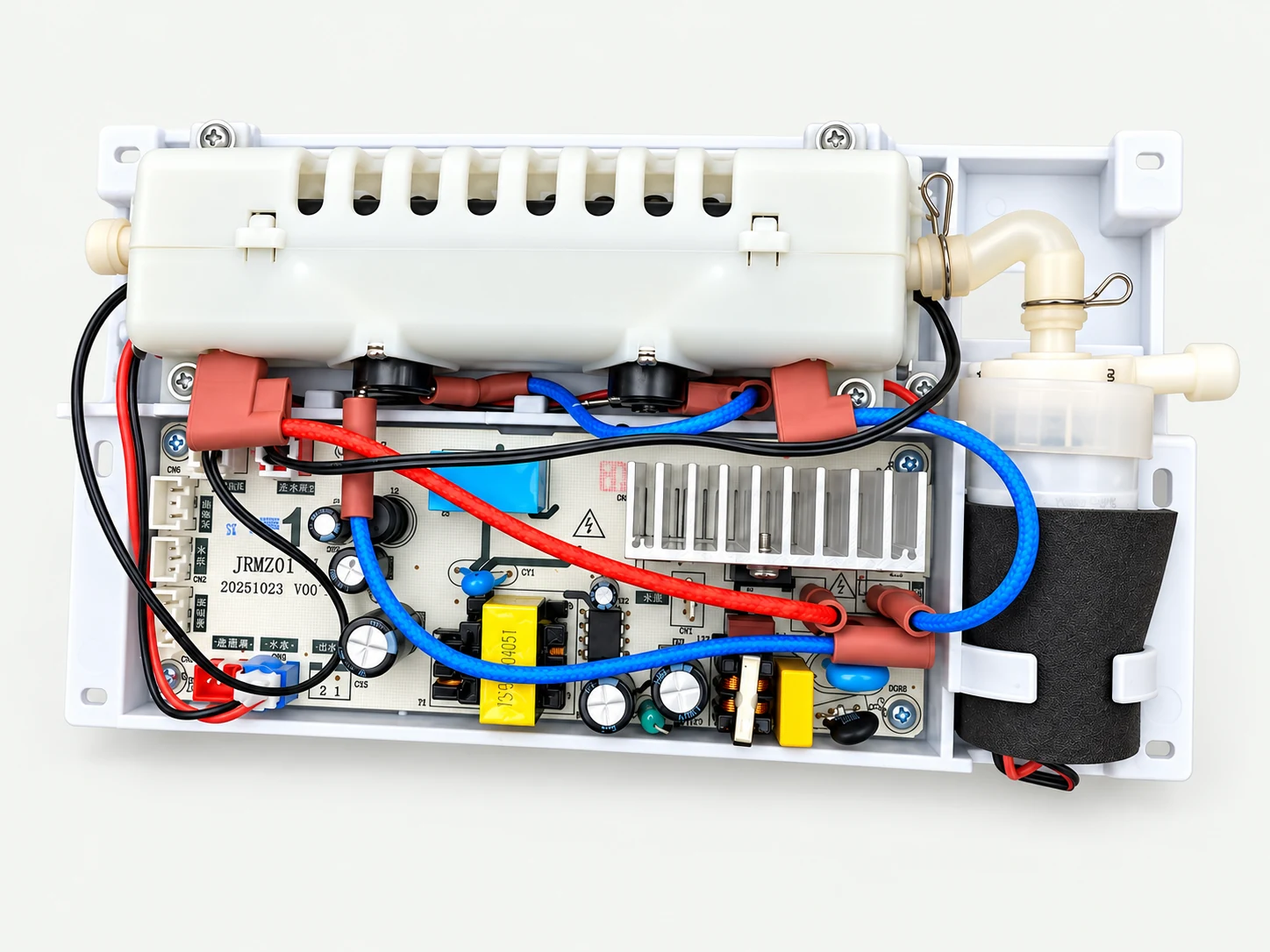
| LL-JRMZ-01 instant-heating module | Heater, pump and controller | Water source, appliance power architecture, enclosure, user interface and system-level compliance |
| LL-JRB heating elements | Heating path, housing, sensing positions and component-level temperature protection | Pump, valves, main controller, grounding and system-level safety |
2. Write the operating conditions before selecting a model
- Cooling: ambient temperature, inlet-water temperature, target cold-water temperature and draw pattern.
- Heating: inlet-water temperature, target outlet temperature, required serving volume or flow and duty cycle.
- Electrical: available voltage, power limit, grounding and protection architecture.
- Mechanical: installation envelope, mounting direction, ports, cable routing and service access.
- Project: target appliance, expected annual quantity, validation stage and required documents.
A rated value without its stated condition should not be treated as final appliance performance.
3. Use the model range as a shortlist
| Model | Product boundary | Published reason to shortlist |
|---|---|---|
| LL-08B | Complete thermoelectric cooling module | 0.8 L cold tank, compact compressor-free architecture and published cold-water output conditions |
| LL-JRMZ-01 | Complete instant-heating module | Heater, pump and controller combined for adjustable temperature and controlled-volume dispensing |
| LL-JRB-003 | Heating element | Compact 2100 W option in a 50×36×136 mm envelope |
| LL-JRB-004A | Heating element | 2200 W option in the shared 004 housing |
| LL-JRB-004B | Heating element | 3000 W option in the shared 004 housing |
| LL-JRB-002 | Heating element | 3500 W option for appliances designed for its electrical and water-control requirements |
4. Finish with an appliance-level validation plan
The selected part still has to be validated inside the target appliance. The review should cover the real water path, airflow or heat rejection, electrical protection, control sequence, installation direction and repeatable test conditions.
- Use the current specification and drawing revision for the named model.
- Record inlet conditions, ambient conditions, voltage and test sequence.
- Verify interfaces and mounting before prototype tooling is fixed.
- Confirm performance and safety behavior in the assembled appliance.