
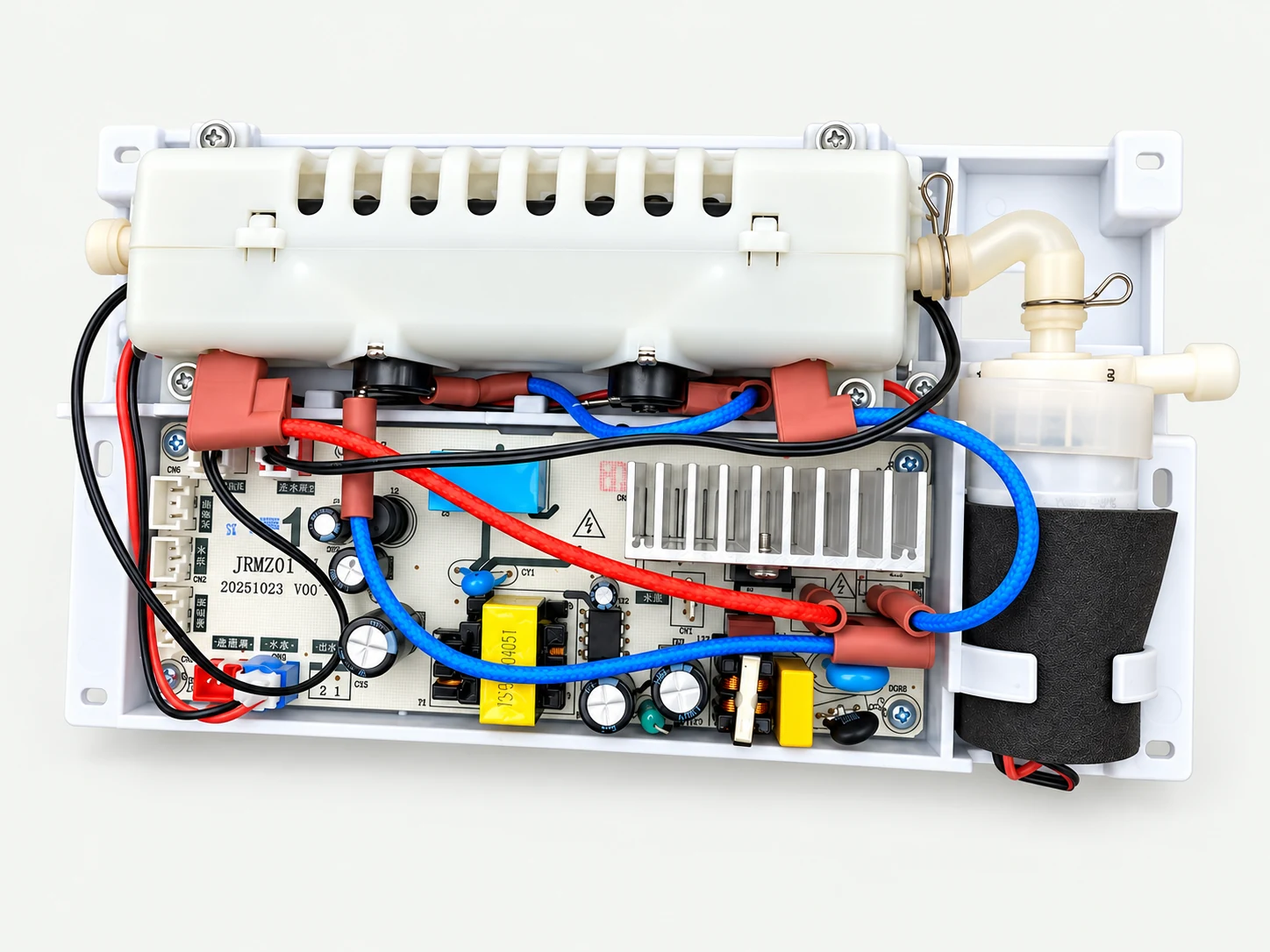
Selection takeaway
Use the energy balance as a screening calculation, then validate the selected module or element in the real appliance. A calculated flow is not a product guarantee.
1. Define the three quantities before comparing products
| Quantity | Unit | What it means |
|---|---|---|
| Input power P | kW | Electrical or thermal power available to heat the flowing water |
| Water flow Q | L/min | Water volume that passes through the heating path each minute |
| Temperature rise ΔT | °C | Target outlet temperature minus inlet-water temperature |
Use the lowest expected inlet-water temperature when screening a demanding operating condition.
2. Use the energy balance for a first-pass estimate
For liquid water, a practical SI approximation is P(kW) ≈ 0.0698 × Q(L/min) × ΔT(°C) ÷ η, where η is the decimal heating efficiency. Rearranging the same expression estimates flow or temperature rise.
- Required power: P ≈ 0.0698 × Q × ΔT ÷ η.
- Ideal flow: Q ≈ P × η ÷ (0.0698 × ΔT).
- Ideal temperature rise: ΔT ≈ P × η ÷ (0.0698 × Q).
The coefficient uses water density near 1 kg/L and specific heat near 4.19 kJ/(kg·K). Use measured properties and the agreed test method when higher precision is required.
3. See how temperature rise changes the ideal flow
The table below uses 2.1 kW and η = 1.00 only to show the physical relationship. It is an ideal upper-bound calculation, not the rated output of LL-JRMZ-01 or any JRB element.
| Temperature rise | Example inlet → outlet | Ideal flow at 2.1 kW |
|---|---|---|
| 30°C | 20°C → 50°C | about 1.00 L/min |
| 50°C | 20°C → 70°C | about 0.60 L/min |
| 70°C | 20°C → 90°C | about 0.43 L/min |
| 75°C | 25°C → 100°C | about 0.40 L/min |
As the required temperature rise increases, the achievable flow falls for the same power. Real output will also reflect efficiency, power tolerance, voltage, pump curve and control behavior.
4. Keep the product boundary in the calculation
| Product group | What is already included | What still controls the appliance result |
|---|---|---|
| LL-JRMZ-01 complete module | 2100 W heater, pump and controller | Inlet condition, rated supply, installation, appliance water source, duty cycle and system validation |
| LL-JRB heating element | Heating path, sensing positions and component-level protection | Pump, valves, main controller, flow control, power architecture and system safety |
The published room-temperature water-path flow for a JRB element is not its guaranteed hot-water output.
5. Send the conditions needed for model review
- Minimum and typical inlet-water temperature.
- Target outlet temperatures and whether boiling output is required.
- Required serving volume, flow, dispense time and interval between cycles.
- Available voltage, frequency, power ceiling and protection architecture.
- Existing pump, valves, sensors and main-control strategy.
- Installation envelope, mounting direction, water ports and annual quantity.