
Thermoelectric cooling is a strong candidate for compact appliances with low to moderate and predictable cooling demand. Compressor cooling deserves review when the appliance must recover from larger or more continuous loads. Neither architecture should be selected from the word “cooling” alone.
1. Define the demand profile before comparing hardware
A tank temperature at one moment does not describe the required system. OEM teams should define how much water is drawn, how often it is drawn and how quickly the appliance must recover under the worst expected inlet and ambient conditions.
- Cold-water volume required in each draw and across one hour.
- Maximum interval between repeated draws and acceptable recovery time.
- Inlet-water and ambient-temperature range for the target market.
- Required outlet-temperature threshold and how it will be measured.
- Available cabinet airflow, electrical power, installation volume and acoustic target.
2. Compare the complete cooling systems
| Decision factor | Thermoelectric architecture | Compressor architecture |
|---|---|---|
| Cooling engine | A semiconductor TEC moves heat when supplied with DC power | A compressor circulates refrigerant through a refrigeration circuit |
| Moving parts | The TEC itself is solid state; a complete assembly may still use a fan or pump | The system includes a compressor and normally one or more fans |
| Heat rejection | The hot side must reject pumped heat plus electrical input to the cabinet air | The condenser must reject absorbed heat and compressor work |
| Installation | Compact assemblies can support flexible equipment layouts, subject to airflow and condensate design | The refrigerant circuit, compressor, condenser and service arrangement need more appliance-level planning |
| Capacity behavior | Best suited to loads that remain inside the validated TEC, heat-sink and airflow envelope | Often considered for larger continuous loads or faster recovery requirements |
| Control and supply | Requires a suitable DC supply and temperature-control strategy | Requires the specified compressor starting, protection and refrigeration controls |
3. When thermoelectric cooling is a practical starting point
Official thermoelectric design references consistently position TEC systems around compact size, low to moderate heat loads, low vibration and precise or localized temperature control. The exact limit depends on temperature lift, hot-side design and operating conditions, so a universal wattage cutoff should not be copied into an appliance specification.
- The appliance has a compact and predictable drinking-water duty rather than a large continuous draw.
- A compressor and refrigerant circuit would add unnecessary volume or integration complexity.
- The product architecture already provides a suitable DC supply and control interface.
- Low vibration, flexible mounting or localized cooling has value for the finished appliance.
- The cabinet can provide a clear hot-air path and manage condensation around cold surfaces.
4. When compressor cooling should remain in the comparison
As heat load and required recovery rate increase, the compactness advantage of thermoelectric cooling may be outweighed by capacity and efficiency needs. A compressor option should remain under review when the appliance must serve repeated large draws, operate in high ambient conditions or maintain a higher continuous cooling duty.
- Compare both systems at the same inlet temperature, target water temperature, ambient condition and draw sequence.
- Include the complete system volume, power electronics, condenser or heat sink, airflow and service access.
- Account for compressor starting behavior and refrigerant-system requirements where applicable.
- Account for TEC electrical input, hot-side heat rejection and condensation management where applicable.
- Make the final decision from prototype results inside the target cabinet, not from a bare cooling-device rating.
5. Place LL-08B inside the correct decision boundary
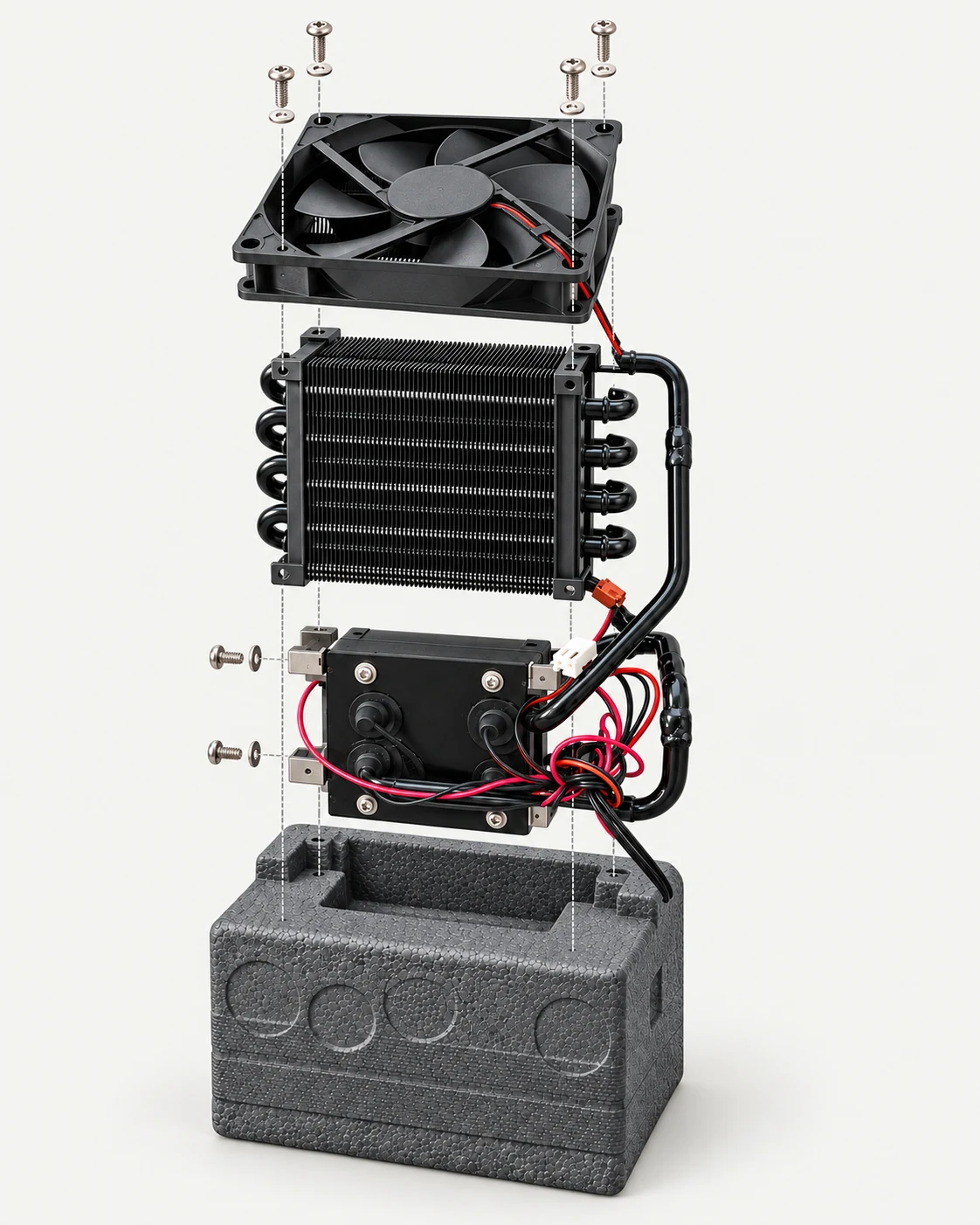
LL-08B is a complete 0.8 L thermoelectric water cooling module rather than a bare TEC. It combines the insulated tank, two 12706 TEC devices, cold-side conduction, heat-pipe heat rejection, fan and two NTC sensors. The OEM appliance still supplies the correct DC arrangement, water connections, mounting, cabinet airflow and control integration.
| Published LL-08B item | Value or condition |
|---|---|
| Rated input | 130 ±10 W |
| Module envelope | 165 × 115 × 308 mm |
| Published cold-water output | >2 L/h at ≤10°C; >3.2 L/h at ≤15°C |
| Published test conditions | 25°C ambient and inlet water, rated electrical input, unobstructed fan inlet and outlet, first draw excluded |
6. Build an apples-to-apples prototype test
- Use the same starting water volume, inlet temperature, ambient temperature and target threshold.
- Record outlet temperature and available volume across the real draw schedule.
- Record recovery time, electrical input, cabinet inlet and exhaust temperatures and acoustic behavior.
- Check condensation, drainage, nearby component temperatures and service clearance.
- Repeat the test at the worst expected market condition before freezing the appliance structure.