
Selection takeaway
Start with what is known. Appliance type, target temperatures, water conditions, power, installation space and system boundary are enough for a first review; detailed drawings can follow when the direction is suitable.
1. Identify the project and appliance
- Company, contact person, country or region and target market.
- Appliance type: water dispenser, purifier-dispenser, tea or beverage equipment, integrated hot-and-cold appliance or another water appliance.
- Project stage: concept, engineering design, prototype, appliance validation, second source, pilot production or mass-production planning.
- Expected annual quantity and target sample or launch timing, if available.
2. Provide the conditions for the product boundary
| Product boundary | Conditions needed for the first review |
|---|---|
| Complete cooling module | Ambient and inlet-water range; target cold-water temperature; draw volume and interval; DC supply; cabinet airflow and nearby heat sources |
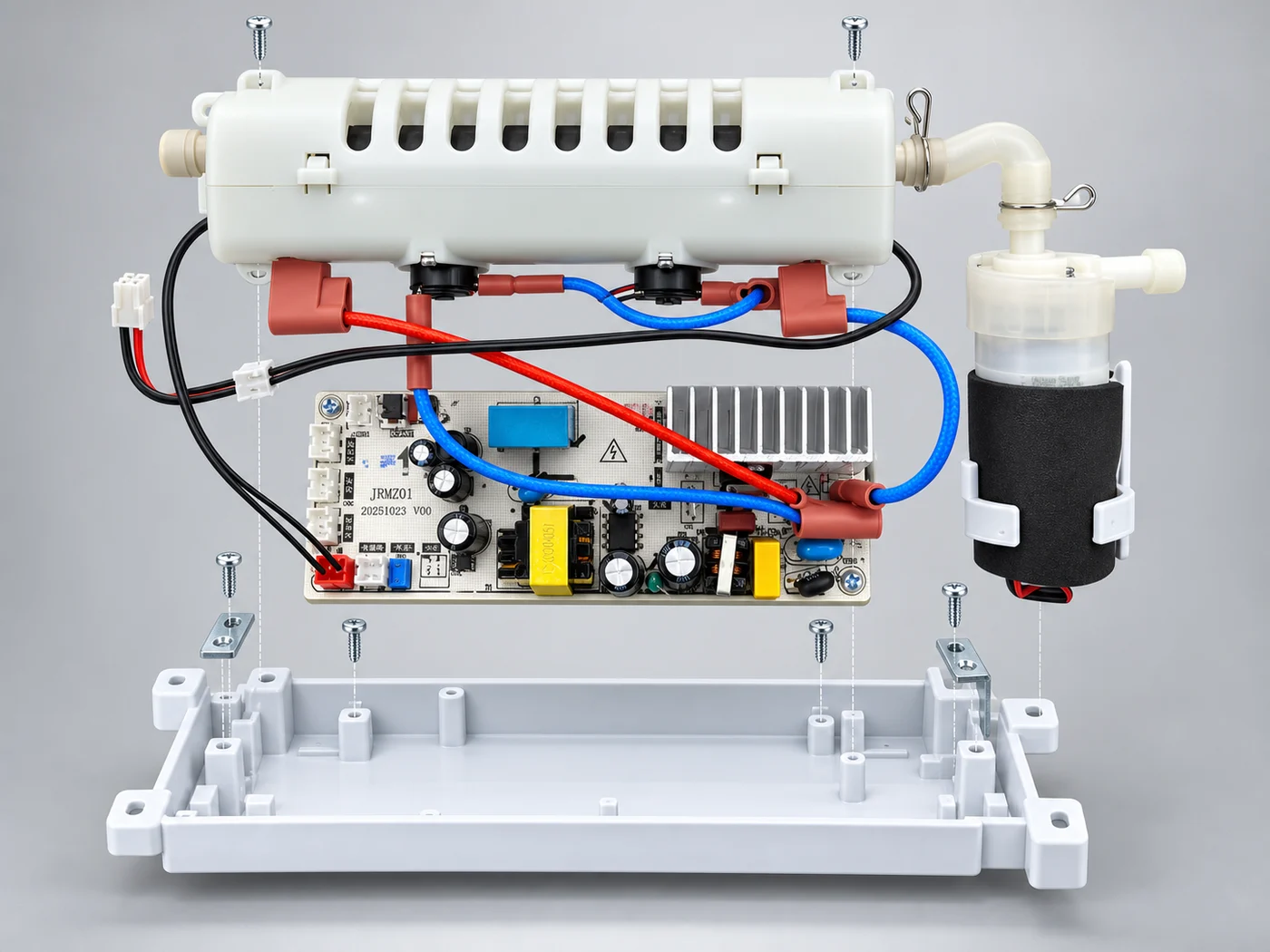
| Complete instant-heating module | Supply voltage and frequency; inlet and target outlet temperatures; serving volume and interval; appliance power, interface and safety architecture |
| Heating element | Supply and power limit; inlet and target outlet temperatures; required flow and duty cycle; existing pump, valves, main controller and protection logic |
If the product boundary is not yet known, describe the appliance function and mark the model field as “Help me select a model.”
3. Record installation and interface constraints
- Available length × width × height in millimetres.
- Required mounting direction and whether the outlet can face upward.
- Water-port location, tube specification and surrounding water-path arrangement.
- Mounting-hole position, cable route, connector requirements and grounding arrangement.
- Air inlet, hot-air outlet and service clearance for a cooling project.
4. Attach only the material available now
| Useful for the first review | Useful after a starting direction is agreed |
|---|---|
| Envelope dimensions, appliance photo, marked-up sketch, water-path diagram and interface notes | Current appliance drawing, prototype test record, control sequence, verification plan and approved document revision |
A first review does not require confidential BOM, supplier or cost information. A redacted drawing or dimensioned sketch can be used when full CAD is not appropriate.
5. Use the review result as a starting configuration
The first response should identify a possible product boundary, a starting model and the missing conditions that affect the next decision. It is not a substitute for appliance-level validation.
- Confirm the named model and current document revision.
- List unresolved electrical, water-path, control, thermal or mounting questions.
- Define the sample and test conditions before comparing results.
- Lock the approved configuration only after validation in the target appliance.